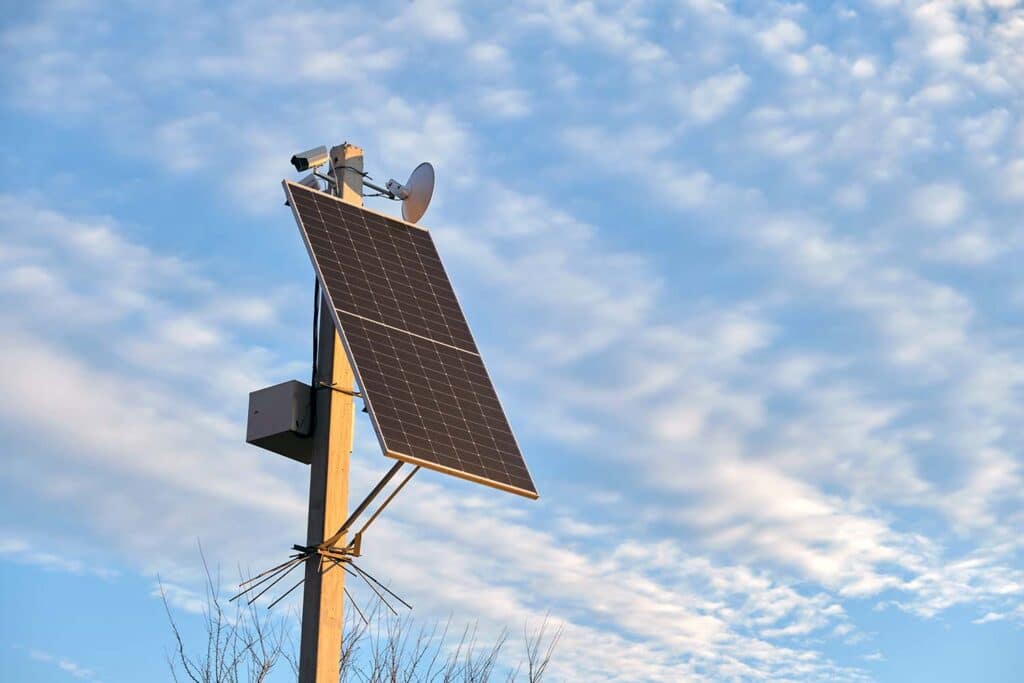
What Are Solar-Powered Mobile Surveillance Units?

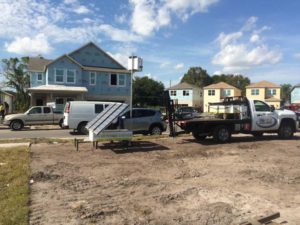
A mobile surveillance unit is built to secure a property that lacks hardwired reliable electricity or internet that a “fixed” camera system would use.
What Are Solar-Powered Mobile Surveillance Units

Table of Contents

Quick Answer 

Mobile surveillance units, sometimes called mobile surveillance trailers or remote surveillance trailers, are movable, solar-powered camera systems that bring live video monitoring to sites with no electricity or Wi-Fi. Instead of hardwired cameras tied to a building, a mobile unit typically runs on solar panels and 5G cellular support, so it can be dropped onto something like a construction site, ranch, or remote oil pipeline and start protecting the property immediately.

Key Takeaways

  • Mobile surveillance units run on solar power and cellular connectivity, so they work on sites with no electrical or internet infrastructure at all
  • Since 2024, mobile units have processed 2.7 million motion alerts and prevented 517 crimes for one Pro-Vigil customer alone
  • Common use cases include construction sites, ranch and agricultural land, seasonal operations, and disaster recovery zones; they’re useful anywhere infrastructure is limited or temporary

Construction sites, ranchland, and disaster-recovery zones rarely come with a working power outlet or Wi-Fi router attached. Mobile surveillance units carry their own power and connectivity with them, making them perfect to close that gap.

What Makes a Surveillance Unit “Mobile”?

When we use the term “mobile,” we’re referring to the entire set of equipment rather than just the camera. A mobile surveillance unit is built to secure a property that lacks hardwired reliable electricity or internet that a “fixed” camera system would use. Instead of running conduit and tying into a building’s power, the entire unit (including camera, power source, and connection to monitoring teams) travels together and can be relocated as a project moves.

That makes mobile surveillance trailers a natural fit for short-term or temporary security needs, like a job site that will look completely different in six months or a property that doesn’t have permanent security infrastructure at all.

Solar Powered Security, No Grid Needed

Each unit boasts a solar panel as well as a cellular aircard; this lets it operate effectively anywhere, no wired power or Wi-Fi necessary. You don’t need to wait for an electrician or for a utility hookup to secure your site, since the unit generates and transmits everything it needs on its own.

Solar-powered units still need to be looked after, though. They’re durable, but they aren’t invulnerable, after all. It’s important to use a mobile surveillance provider like Pro-Vigil that has an equipment status monitoring service that checks the health of every mobile unit remotely. This means that a lower-than-expected battery (say, after a long overcast period) or a weak cellular signal can be noticed before they become blind spots, rather than afterwards.

Pro-Vigil Tip: Ask how a solar-powered unit performs after a stretch of overcast weather, rather than just on a demo scheduled for a sunny afternoon. This will ensure you get a mobile surveillance system that can survive bad weather and doesn’t just require optimal conditio

Built for Sites Without Infrastructure
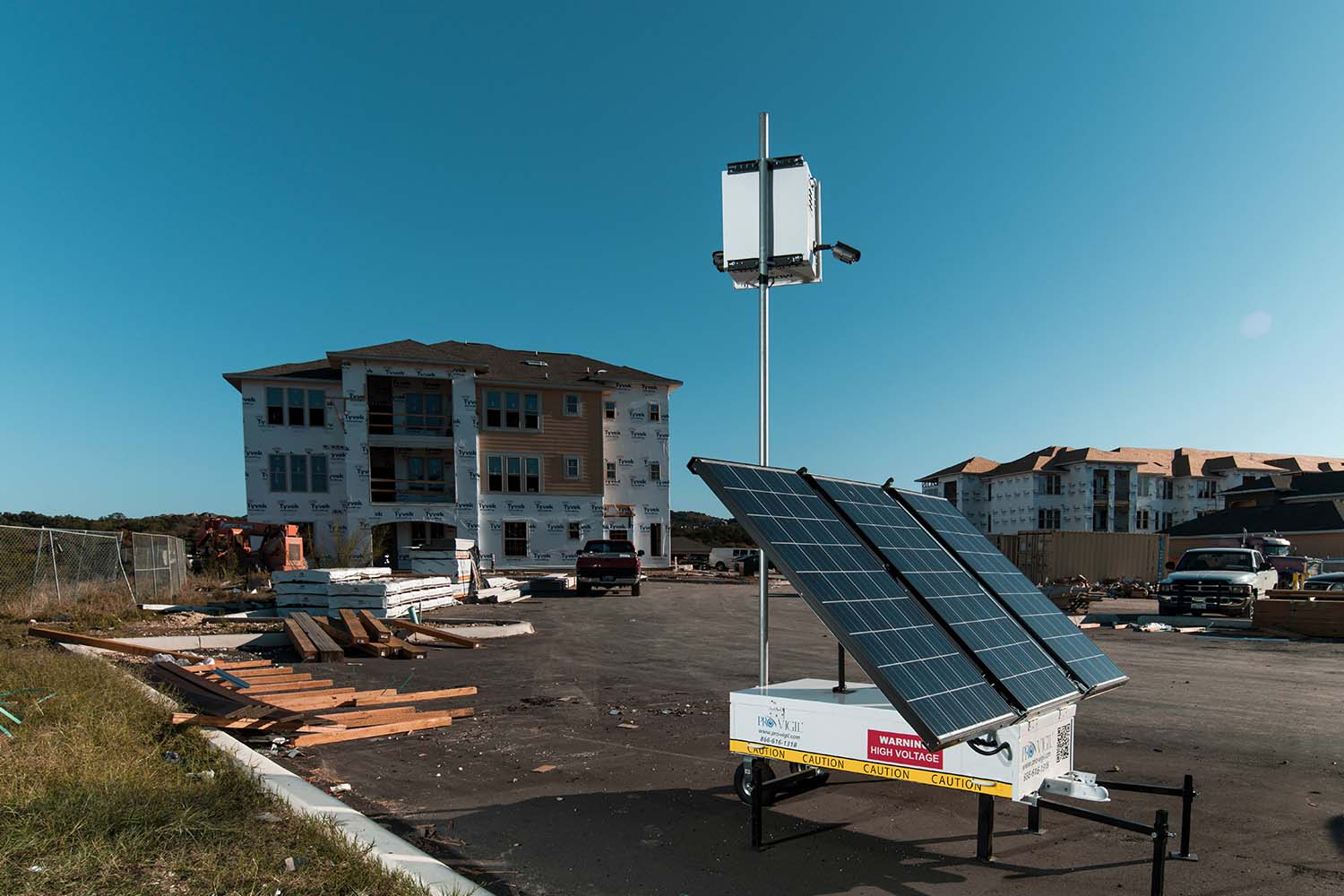
Built for Sites Without Infrastructure

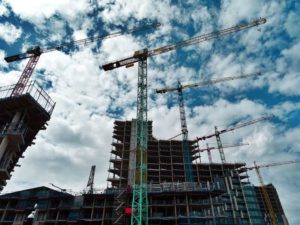
Remote surveillance trailers exist because so many properties don’t have the infrastructure a typical security camera assumes – but that doesn’t make them not worth protecting. For instance, construction sites move through phases and rarely have permanent power, especially early on in the process. Oil and gas infrastructure or ranch and agricultural land can span thousands of acres with no wiring anywhere near the parts you’d want to be monitoring. And temporary lots, disaster recovery zones, or major event sites often need coverage measured in spans of weeks, not years.

In all of these cases, a mobile unit can be deployed in a fraction of the time it would take to get a “fixed” hardwired system online.

Industries That Benefit from Mobile Surveillance Units

  • Construction sites: They provide coverage that follows the project through each phase, with no need to wait on permanent power preventing bottlenecks (or worse – unsecure operations)
  • Ranch and agricultural land: Mobile units offer protection across potentially vast amounts of acreage with no wired infrastructure nearby
  • Seasonal or temporary operations: Security can easily scale up and down depending on the length of the project 
  • Disaster recovery and emergency response sites: Mobile units are able to be quickly deployed; rapid deployment is invaluable where existing infrastructure may be damaged or unavailable
  • High-value shipments and event spaces: If you want short-term coverage without a long-term installation for a festival or other event – or for a critical shipment that will only be around for a short time – these are perfect
  • Parking lots: Secure long-term, overflow, and employee lots that see break-ins and vandalism but rarely have any on-site security wiring
  • Vacant land and properties: Mobile units can protect undeveloped lots or buildings sitting between tenants that attract squatting, dumping, and theft, but which rarely have active power
  • Scrap and recycling yards: Sprawling outdoor yards often hold valuable metal, with acreage too large to wire end-to-end, making them ideal for mobile security trailers
  • Oil, gas, and utility infrastructure: Mobile units can safeguard things like remote well pads, substations, or pipeline segments far from the nearest power line, just to name a few
  • Heavy equipment and logistics yards: Trailers, machinery, and freight are staged between job assignments, and often have no fixed security in place.

Mobility Means Coverage That Moves With the Job

A fixed camera system is tied to the building it’s mounted on, and therefore isn’t very easily moved. A mobile surveillance unit, as the name suggests, has no such limitation; it can move to wherever the risk currently is, which matters most for operations that don’t sit still. 

A construction company like D.R Horton works (at minimum) dozens of sites a year, each at a different stage of vulnerability. A mobile unit can follow the highest-risk phase of the job instead of staying behind at a site that’s already secured, and can even move from site to site as construction wraps up on Project A and spins up on Project B.

“The money we were spending on replacement materials and damage repair was getting out of control… We strategically placed mobile units… and have absolutely noticed a decline in incidents.”

— Joe Walston, D.R. Horton (Real Pro-Vigil customer)

Cover More Ground With Pro-Vigil’s Mobile Surveillance Units

Pro-Vigil’s solar-powered mobile surveillance units bring the same AI-powered detection, live audiovisual deterrents with two-way communication, and experienced active monitoring team as a fixed camera system does to sites that have no power or internet of their own.

Learn more about Pro-Vigil’s mobile surveillance systems. Want to see how we can help you protect your remote sites, like we’ve helped countless businesses around the country secure their property? Contact us today.

Mobile Surveillance Unit FAQs

Yes, though how long it can go without a full charge depends on the specific unit's battery capacity and how much sun the site really gets on a day-to-day basis. A well-made system is built to keep running, even through a multi-day overcast stretch. This is why it’s worth asking a provider how their units perform in weeks with less sun. Always make sure you check how units perform in less-than-ideal conditions when onboarding a new security provider.

Here are a few questions worth asking up front:

  • How does the unit perform through extended cloudy or overcast weather, not just a sunny demo?
  • Is footage watched live by a monitoring team, or just recorded to a drive for later review?
  • What happens if a unit needs to relocate mid-project? How long does that take, and how much downtime does that involve?
  • Is equipment health (battery, signal strength, camera status) monitored remotely?

With the right mobile surveillance system provider, it does. Pro-Vigil's active monitoring works for mobile and fixed cameras equally. When you use mobile surveillance units, you aren’t getting a second tier of coverage; it's the exact same detection and response, just running on different hardware.

Yes, and this is actually quite a common setup for larger or mixed-use properties. A building with reliable power might run fixed cameras on most of the perimeter, while a mobile unit covers a parking lot, staging area, or section still under development. This is commonly seen in big supermarkets, where there are internal cameras as well as mobile units for the parking lot.

Yes; mobile units are typically designed to be deployed in outdoor, unattended environments, since that's the whole point of a mobile deployment. That said, they're durable rather than indestructible, so remote equipment health monitoring still matters – you don’t want to notice that one of your units has a damaged solar panel when you go to pull footage of an incident and realize it’s been offline for weeks.

Picture of Jeremy White

Jeremy White

Jeremy White is Chief Commercial Officer, ECAM MARKET at ECAM. He founded Pro-Vigil, an AI-powered remote video monitoring provider in 2006, helping pioneer the remote video monitoring industry. In 2026, Pro-Vigil joined forces with ECAM, North America's undisputed #1 in remote video monitoring. With deep expertise in AI-powered surveillance, video analytics, and proactive crime deterrence—he spent the past two decades pioneering the remote video monitoring and security-as-a-service industries.

Connect with Jeremy on LinkedIn.
Share This Post
Facebook
Twitter
LinkedIn
Email

Security | Surveillance | Management | Compliance | Inspection
© 2020 Pro-Vigil. All Rights Reserved.