


When people first hear about thermal security cameras and night vision, it’s easy to assume they’re interchangeable, since both promise visibility in low-light or no-light conditions. But in reality, they work on fundamentally different principles, each with distinct strengths, weaknesses, and ideal applications.
Thermal security cameras detect heat (infrared radiation) emitted by objects instead of relying on visible light. This allows them to produce clear images in total darkness, through fog, smoke, and other translucent visual obstructions. Night vision cameras, in contrast, amplify existing light — even tiny amounts from starlight or moonlight — to create a visible image. That difference makes the thermal vs. night vision cameras conversation more about physics than it is about branding.
In commercial security settings like parking lots, construction sites, or remote industrial facilities, choosing between thermal and night vision is rarely about image sharpness alone. It’s about detection range, reaction time, environmental factors, and whether intruders can conceal themselves. For instance, thermal security cameras can detect a person hiding behind vegetation by sensing body heat, while infrared night vision might struggle if the foliage blocks the view.
In the sections ahead, we’ll break down how each technology works, compare pros and cons, and explore when to use one, the other, or both.
How Thermal Security Cameras Work

Thermal security cameras operate on a principle that’s completely independent of visible light. Every object above absolute zero emits some level of infrared radiation, and the hotter the object, the more energy it emits. Thermal cameras capture this radiation using specialized sensors, then translate it into an image where differences in temperature appear as contrasting shades or colors.
The key advantage here is that visibility doesn’t depend on daylight, streetlamps, or other light sources. Even in pitch-black conditions, a thermal camera can detect warm bodies, hot machinery, or even a recently driven vehicle. That makes them highly effective in situations where lighting is poor or inconsistent — think rural construction sites, expansive storage yards, or the unlit corners of a large parking lot.
Thermal cameras are also resistant to many common visibility issues. Fog, smoke, light rain, and even partial visual obstructions often have little impact on thermal detection because the technology “sees” heat rather than reflected light.
However, they’re not perfect. While thermal security cameras excel at detecting presence, they can struggle with identifying fine details. You’ll know someone is there, but you might not be able to read a license plate or see a facial expression. This is why many businesses use them in conjunction with other camera systems, creating a layered security approach.
In practical terms, thermal systems are especially good at:
Up next, we’ll look at how infrared night vision cameras work and why they can sometimes be a better choice for identification, even if they don’t match thermal performance in raw detection.
How Infrared and Night Vision Cameras Work

Night vision cameras operate very differently from thermal security cameras. Instead of detecting heat, they rely on amplifying existing light, whether it’s from the moon, stars, nearby streetlamps, or dedicated infrared (IR) illuminators. This light, which may be invisible to the human eye, is collected and intensified by the camera’s sensor to produce a clear, usable image.
There are two primary types of night vision used in security applications:
With both technologies offering unique benefits, the next step is comparing thermal vs. night vision cameras side by side to understand where each one excels — and where it might fall short.
Thermal vs. Night Vision Cameras: How Do They Stack Up?
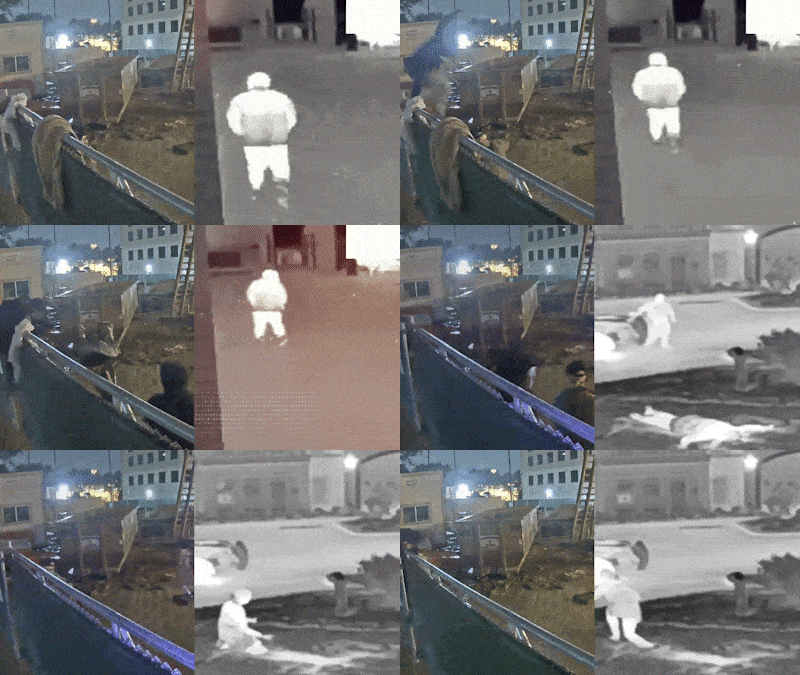
When deciding between thermal security cameras and night vision cameras, the choice often comes down to detection vs identification.
Thermal security cameras