
Quick Answer
By most current measures, New York City is a fairly safe city by the standards of large American cities, especially when it comes to the most serious crimes. 2026 is on pace to be the safest year in NYPD’s recorded history for murders and shootings, extending a sharp decline that’s been underway since the post-COVID crime spike in 2021. Among the 50 largest U.S. cities, NYC’s murder rate ranks near the bottom, though its overall violent crime rate sits closer to the middle of the pack. New York State’s safest cities and towns, meanwhile, are concentrated in the suburbs just north of the city.
Key Takeaways
- NYC has recorded 173 murders and 538 shooting victims through August 2026, both the fewest ever recorded for that period, down 24% and 12% respectively from 2025’s already-record pace, per the NYPD.
- Shooting victims have fallen roughly 55% since 2021 (compare 852 in the first half of 2021 to 381 in the first half of 2026).
- Among the 50 largest U.S. cities, NYC’s murder rate ranked 8th lowest and its property crime rate ranked 6th lowest in the most recent full year of FBI data.
- Its overall violent crime rate, however, landed closer to the middle of that same group.
- However, some non-violent complaint categories have risen even as major crime has fallen, and New Yorkers report worrying about crime more than they did a year ago.
- New York’s safest cities in 2026 are concentrated in NYC’s northern suburbs, with Rye, Bedford, and Scarsdale in Westchester County topping the list.
So, what does the data actually show for the Empire State and the Big Apple?
Is New York City Safe?
2026 has been a record-setting year for New York City’s crime – in a good way. NYPD data shows the city’s crime rate continuing to plummet following the COVID-era crime surge, reaching its lowest recorded violent crime rate yet.
Through the first eight months of the year, the city logged 173 murders and 538 shooting victims – and while that may sound like a lot, consider that NYC is a very large city. These numbers are the fewest ever recorded for that stretch, beating the previous records set just the year before. That builds on a longer trend; shooting victims are down roughly 55% since the first half of 2021, and the murder rate has fallen nearly 90% per capita since 1990, according to the Brennan Center for Justice, while the nation overall has seen just 45% decline over that same period.
Compared to other large American cities, NYC holds up well on the crimes that carry the highest stakes. In 2024, the most recent year with complete FBI data, per the Brennan Center:
- New York’s murder rate ranked 8th lowest among the 50 largest U.S. cities
- Its property crime rate ranked 6th lowest
However, its overall violent crime rate – a broader category that includes robbery and aggravated assault alongside murder – does tell a less flattering story. Currently, NYC lands squarely in the middle of the aforementioned 50-city group. It’s not top-tier, but nowhere near the country’s most dangerous large cities either.
Additionally, some non-violent complaint categories have climbed even as index crime falls, and New Yorkers report feeling less safe than they did a year ago: 60% say they worry about crime daily, up from 47%, according to SafeWise’s 2026 survey data. Another worrying number is the amount of reported rapes, which rose year-over-year, though the NYPD attributes at least part of that increase to a 2024 state law that broadened the legal definition of rape – so an increased number of reports might not actually mean an increased number of assaults, thankfully.
How NYC Crime Compares to Other Major U.S. Cities
Big cities generally have higher crime rates than the national average, which includes many small towns and suburbs with little reported crime at all. So, let’s compare New York to some of its big-city peers around the country.
| City | Violent Crime Rate (per 100K) |
| New York City | 671 |
| Los Angeles | 729 |
| Chicago | 539 |
| Houston | 1,148 |
| Phoenix | 799 |
(Caveat to this data – Chicago police report a violent crime rate of 695 per 100K, though they also track violent crime more broadly than the FBI does. We’ve used FBI data to be consistent here.)
One thing that stands out is that New York’s murder rate, compared to its peers, is extremely low. While Chicago has a lower overall violent crime rate (depending on the dataset used, see our previous note), its murder rate in 2024 was 17.5 per 100K, nearly four times that of NYC’s ~4.1 per 100k.
And the country’s highest-crime large cities operate on an entirely different scale of risk. Memphis’ violent crime rate is more than five-and-a-half times the national average (even Houston, the highest of the big cities, is only 220% above average here). New Orleans and Memphis top the table with the ignominious title of “worst murder rates,” at 46 and 41 per 100k, respectively – over twice as bad as Chicago and ten times as bad as New York.
Which NYC Borough Is Safest?
Staten Island consistently ranks as New York City’s safest borough by per-capita crime rate – perhaps unsurprisingly, it’s also the least populous. The remaining four typically run: Queens, Manhattan, Brooklyn, and the Bronx.
The Bronx carries the city’s highest concentration of violent crime; six of the city’s ten highest-violent-crime precincts are located there. That said, every borough has both safer and higher-crime pockets. For instance, Riverdale, in the Bronx, regularly outperforms most Manhattan neighborhoods on crime data – this just goes to show how safety varies within a single borough, not just between them.
The Safest Cities in New York State
Statewide, New York’s numbers are slightly above the national average; it has a violent crime rate of 5.73 per 1,000 residents compared to a national rate of 4.43, and a property crime rate of 23.72 per 1,000 compared to a national rate of 22.89 nationally, according to SafeWise. But that statewide figure hides enormous variation, and the state’s safest cities post some of the lowest crime rates anywhere in the country.
| Rank | City | Population | Violent Crime Rate (per 1,000) | Property Crime Rate (per 1,000) |
| 1 | Rye | 16,094 | 0.1 | 2.5 |
| 2 | Bedford | 16,196 | 0.2 | 2.5 |
| 3 | Scarsdale | 17,602 | 0.1 | 3.6 |
| 4 | East Fishkill | 29,607 | 0.2 | 4.3 |
| 5 | Hyde Park | 21,180 | 0.5 | 4.1 |
| 6 | Saugerties | 19,468 | 0.5 | 5.4 |
| 7 | Ogden | 20,082 | 0.4 | 6 |
| 8 | Yorktown | 34,899 | 0.3 | 6.4 |
| 9 | Orangetown | 41,682 | 0.6 | 5.7 |
| 10 | New Paltz | 15,926 | 0.6 | 6.9 |
Every city on this list reported zero murders in the last recorded year, and most also had zero major robberies. New York’s lowest-crime communities are mostly located near the city itself, in the downstate suburbs and Hudson Valley; six of these ten are in or near Westchester County, just north of NYC.
However, it should be noted that small towns produce statistically noisy crime rates – if your town has only a few thousand residents, even one incident can make your rate spike sharply because the underlying numbers are so small.
Protecting Your New York Business
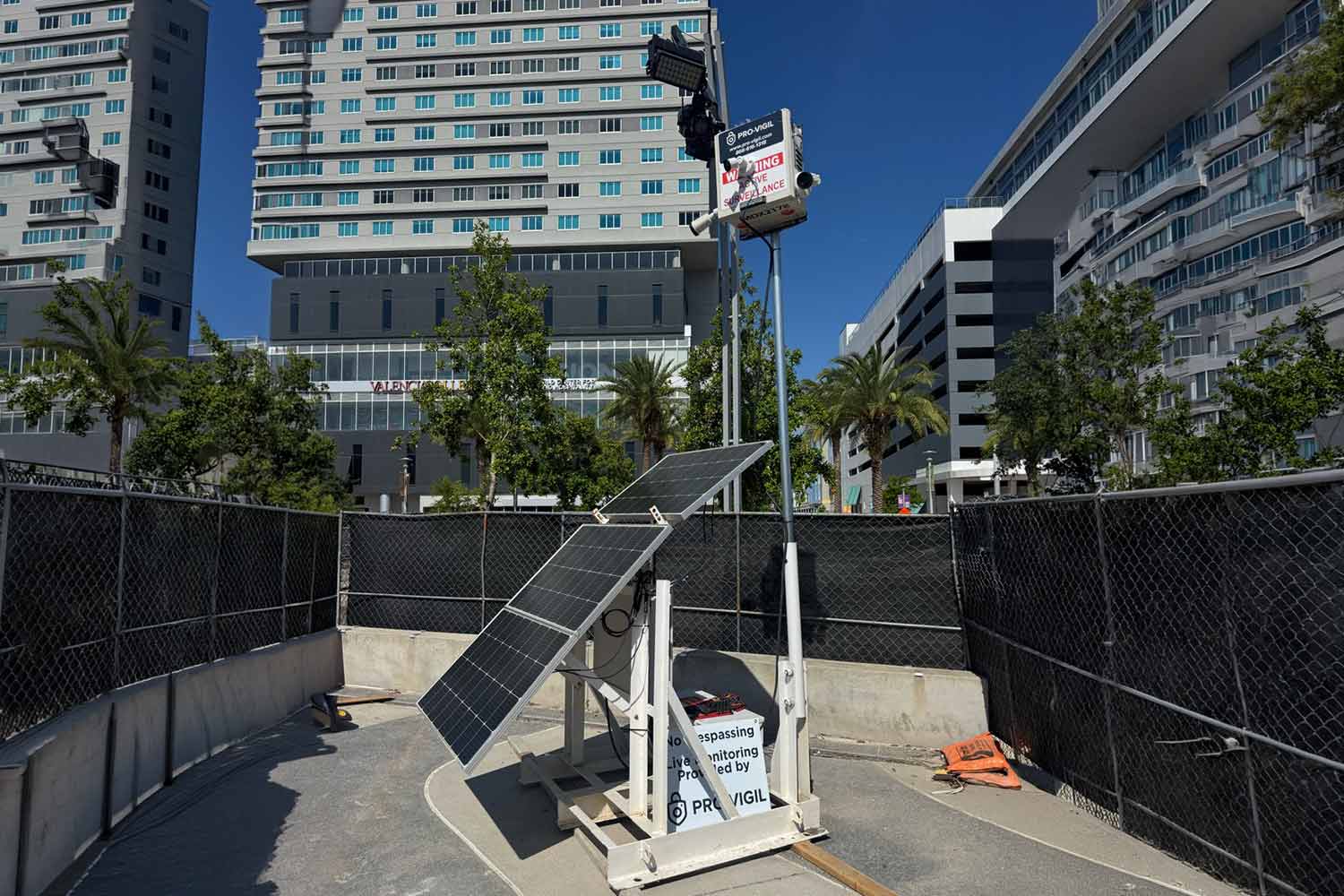
Falling citywide crime numbers are good news, but they don’t erase risk for any individual business. Retail theft, property crime, and other persistent categories haven’t disappeared just because the highest-profile numbers, like murders and shootings, are dropping. Pro-Vigil’s New York video surveillance services pair AI-enabled cameras with live monitoring to help NYC and New York State businesses stay protected regardless of which way the citywide trend line is moving.
New York City Crime FAQs