Hurricane Season Commercial Site Prep: How to Protect Your Property Before a Storm Hits

Equipment prep only solves half the problem, since a storm can knock out a site’s power or connectivity no matter how well the cameras are mounted.
Hurricane Season Commercial Site Prep

Table of Contents

Quick Answer & Key Takeaways

Hurricane season prep means securing structures, equipment, and surveillance coverage before storm conditions arrive, rather than waiting until the last minute when storm warnings come. The 2026 Atlantic season is forecast to be quieter than average, but forecasters are clear that a below-average season can still produce a damaging landfall, and the season’s historical peak is still ahead. Check your camera coverage, backup power, and emergency plan to better position your business for storm season.

  • NOAA’s 2026 outlook gives a 55% chance of a below-normal Atlantic season, with 8 to 14 named storms, 3 to 6 hurricanes, and 1 to 3 major hurricanes expected – below a typical season’s 14 named storms.
  • As of mid-July 2026, the Atlantic basin has been unusually quiet, with no named storms yet, but the season’s historical peak still runs from mid-September through October, so now is the time to prepare.
  • Backup power runtime varies by equipment; high-end solar-powered mobile units can remain functional even in overcast conditions for over a week. Double check the battery runtime on your specific equipment before storms hit.
  • Pro-Vigil doesn’t recommend using generator power for mobile camera units, due to cost and emissions, but it is possible as long as the power supply stays continuous and uninterrupted.
  • If Pro-Vigil relocates a mobile unit itself ahead of a storm, there’s no relocation fee.

Your Hurricane Season Prep Shouldn’t Wait for a Storm Watch

Amidst all of the other climate-related gloom, here’s some good news: NOAA’s 2026 Atlantic hurricane outlook predicts a below-normal season, with a developing El Niño pattern driving higher wind shear that tends to suppress storm formation. As of mid-July, the basin has stayed unusually quiet, with the first named storm of the season yet to form even as Colorado State University revised its forecast down further to nine storms and four hurricanes, which would be one of the least active seasons in over a decade.

A quiet start is not the same as a safe season, though. As NOAA’s National Weather Service Director Ken Graham put it plainly when the outlook was released: “It only takes one storm to make for a very bad season.” The season’s historical peak doesn’t arrive until the middle of September, which means the calm stretch businesses are seeing right now is exactly the window to get equipment and plans in order before conditions change.

What Hurricane Conditions Can Do to a Security System

Modern security cameras are surprisingly hardy, but they’re obviously not invincible. A direct hit from a hurricane that collapses rooftops is going to deal as much damage to a security system as it will everything else, and there’s only so much you can do to prepare for the worst-case scenario.

On the other hand – and far more likely – a storm doesn’t have to make a direct hit to disrupt your business’ security coverage. The most common issues businesses run into include:

  • Grid power outages, which can take fixed cameras and network equipment offline unless backup power is in place.
  • Extended cloud cover, which slows solar charging on mobile units right when battery reserves matter most.
  • Cellular network disruption, since damaged cell towers can interrupt connectivity even when a unit still has power.
  • Physical damage from wind and debris, particularly to poorly secured mounts or exposed cabling.
  • Flooding at ground level, which is more of a risk for equipment enclosures and power connections placed low to the ground.

Pro-Vigil Tip:

In the aftermath of a storm, battery runtime becomes increasingly vital. If a storm knocks out grid power and clouds the sky for several days straight, a unit’s battery is what determines whether coverage holds or goes dark. Confirm the expected battery life for your specific equipment before hurricane season peaks.

Storm Prep for Fixed vs. Mobile Security Camera Systems

Depending on if your deployment primarily uses fixed or mobile security cameras, storm prep looks different for each one. 

Fixed Security Camera Systems
Fixed Security Camera Systems

Fixed systems are hardwired into a facility, so storm prep is largely about securing the building itself.

Check the mounting for any exterior cameras to make sure they’re not at risk of coming loose in strong wind. Confirm your network room has backup power of some sort so that if your internet goes down, your remote video monitoring provider can still check your property. Finally, ensure that your equipment isn’t at risk from water intrusion if the site floods.

Mobile Security Camera System

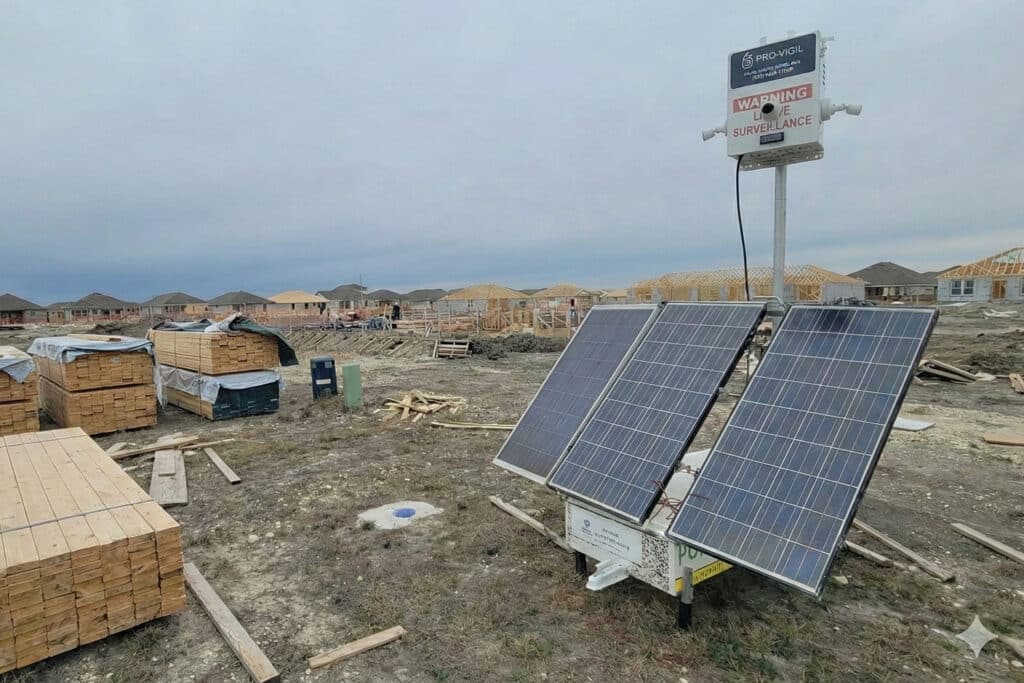
Mobile units are fully exposed to the elements and tend to be powered by solar panels, which makes them more sensitive to extended cloud cover and physical wind damage. (This also, however, makes them more resilient in the aftermath of a hurricane, because they’re not necessary on local power – downed wires don’t knock them offline.) 

Because they’re portable by design, they also come with an option fixed systems don’t: relocating the unit out of harm’s way ahead of a forecast storm, rather than trying to protect it in place. If you have a large interior space, you can bring your mobile trailers inside to weather the storm before redeploying in the aftermath. 

Hurricane Season Security System Prep Checklist

  1. Inspect mounts and housings while the season is quiet, rather than after a storm watch is issued. If a mount is loose or a seal has degraded, repair or replace it now, since wind is exactly the condition that turns a minor issue into a failure.
  2. Check backup battery and UPS runtime for every unit, and confirm it matches your expected needs. If a unit’s runtime falls short, talk to your provider about additional battery capacity or a generator plan before peak season, not after a watch is issued.
  3. Know your relocation options for exposed mobile units before a storm is bearing down, so it isn’t yet another thing you need to coordinate during a scramble. If relocation isn’t practical for a given unit, plan now for extra physical protection instead, like elevated mounting or additional bracing.
  4. Confirm your emergency contact plan, so you know exactly how to reach support if coverage is disrupted. If you don’t already have a direct line to your provider’s support team, get one now rather than after you’ve lost a live feed.
  5. Revisit your plan again closer to peak season. If anything’s changed, e.g., a new unit has been installed or a mount relocated, update the plan then instead of assuming it still holds. 
Pro-Vigil Tip

We don’t recommend running mobile security camera units on generators long-term, mainly due to cost and emissions, but it’s a workable option in a pinch as long as the power stays continuous and uninterrupted. An intermittent generator won’t help you, since the power risks going off when you need it most.

Get Ahead of Hurricane Season With Pro-Vigil

A quieter forecast is good news, but it isn’t a guarantee, and the businesses that fare best after a storm are usually the ones that treated reports of a calmer season as “good prep time” rather than “we’re all in the clear.”

Pro-Vigil can help businesses check whether their current equipment, backup power, and coverage plan are ready for what the rest of the 2026 season brings – and years to come – well before peak season narrows the window to act.

Equipment prep only solves half the problem, since a storm can knock out a site’s power or connectivity no matter how well the cameras are mounted. Pro-Vigil’s Surveillance Operations Center watches sites across the country, so a hurricane affecting a customer’s property doesn’t affect the team watching it, as long as the equipment on-site stays powered and connected. 

Contact Pro-Vigil today for a free quote for your site.

Hurricane Season Prep FAQs

As early in the season as possible, ideally well before the historical peak season starts, which is usually September and October. A quiet start to the season, like 2026 has seen so far, is the best time to inspect equipment and confirm backup power before storm activity picks up.

It's possible, though not the first choice: continuous, uninterrupted power is what matters most, and an inconsistent generator connection can cause disruption.

It depends on backup power and connectivity. Units with sufficient battery reserve can keep running through a power outage, but cellular disruption from damaged infrastructure can interrupt coverage even when a unit still has power.

It's worth considering for units in an exposed, high-risk location, since mobile equipment can be moved out of harm's way in a way fixed systems can't. If your provider handles the relocation, that may come with a fee. Double-check with your provider just to be sure.

Not in any way worth relying on. A below-normal forecast describes overall storm activity across the entire Atlantic basin, not the odds for any one property. A quiet season with only a handful of storms can still produce a damaging direct hit if just one of them happens to track toward your site, and that possibility doesn't change how prepared any individual business needs to be.

Remember: You only need to get unlucky once.

It's worth it where that's an option. Coastal and low-lying sites face a higher chance of both wind and storm surge damage, so starting things like inspections and backup power checks earlier in the season gives more room to act if conditions change quickly, rather than waiting until a specific storm is forecast.

Picture of Jeremy White

Jeremy White

Jeremy White founded Pro-Vigil in 2006 and has spent the past two decades pioneering the remote video monitoring and security-as-a-service industries. With deep expertise in AI-powered surveillance, video analytics, and proactive crime deterrence, he has guided Pro-Vigil to becoming UL-Certified and earning the Five Diamonds Designation by The Monitoring Association — among the highest recognitions in the security industry.

Connect with Jeremy on LinkedIn.
Share This Post
Facebook
Twitter
LinkedIn
Email

Security | Surveillance | Management | Compliance | Inspection
© 2020 Pro-Vigil. All Rights Reserved.