Quick Answer
A strong enterprise camera system does more than merely record footage; it unifies live monitoring, AI-driven analytics, and centralized management so security teams can spot problems and respond to them in real time, no matter the scale of the business. The features that matter most turn a sprawling camera network from dozens of independent, disconnected feeds into a single, actionable security operation.
Key Takeaways:
- 88% of businesses reported physical security incidents either increased or stayed the same in 2025, according to Pro-Vigil’s State of Physical Security report
- 52% of business leaders expect incidents to increase further in 2026
- AI-powered analytics cut down on false alarms by filtering out non-threats
- Centralized, multi-site dashboards let one team manage cameras across dozens of locations from a single interface
- Redundant connectivity (e.g., cellular failover, backup power) keeps a system online during outages, which is often when incidents happen
Enterprise security teams don’t buy cameras one at a time like a small business might. Enterprises buy systems that need to work the same way at a construction site in Texas as they do at a distribution center in Ohio and a car dealership outside of Seattle. Pro-Vigil has found that the businesses getting the most value from their security investment tend to prioritize the same handful of capabilities, regardless of industry.
Here are some of the most important features to look for in an enterprise security camera system.
AI-Powered Video Analytics
Modern AI video analytics filter footage in real time, flagging people, vehicles, and behavior patterns instead of reacting to every flicker of motion, like an older motion-detecting camera might. This can have a huge impact at scale; a five-camera storefront can tolerate a few false alerts over the course of a month, but an enterprise camera network with 200 units is going to be paralyzed with indecision if its operators are chasing shadows all night.
Ideally for enterprise systems, the advantages of AI compound with scale – because there is so much video being recorded and fed to the machine learning algorithm, it learns much more quickly. As Ryan McElderry, Pro-Vigil’s SVP of Operations, put it: “Perhaps the best benefit of using AI is the fact that it becomes more accurate over time.”
Pro-Vigil Tip: Ask any vendor how their analytics reduce false alarms specifically and how (or if) their AI system catalogues incidents. A system that flags fewer irrelevant events is more useful than one that simply flags more events overall.
Live Monitoring
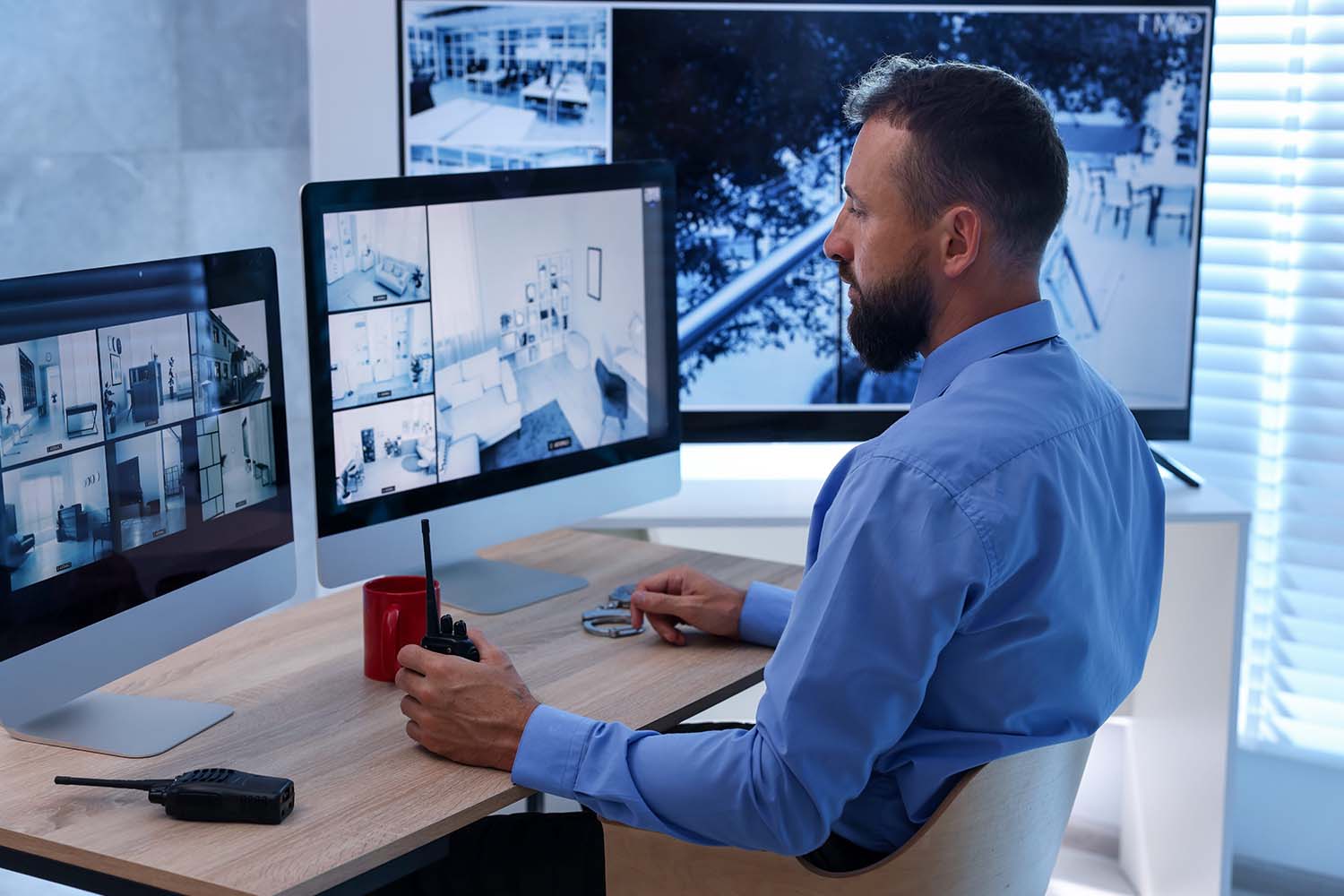
If a potential enterprise security provider tells you that their state-of-the-art offering involves simply recording footage, look elsewhere. Enterprise systems these days need verified live monitoring – trained operators watching feeds so that they can confirm a threat is real and intervene in real time.
Often, these live monitors (sometimes called virtual guards) can deter a threat through audio alarms or communication before law enforcement needs to get involved – but they can dispatch them when needed, too.
Pro-Vigil Tip: If a vendor’s monitoring is alert-based rather than continuous – most are, given the impossibility of watching hundreds of videos at once – ask exactly how fast a human reviews and acts on an alert. The lower the response window, the better. Seconds matter.
Centralized Multi-Site Management
Your business may have multiple properties it owns and manages, but that doesn’t mean you want that many logins to match. An enterprise camera system needs one dashboard to be a single point of truth. Centralized management gives security leaders a single view across every location, including live feeds, historical footage, incident logs, and system health, without switching platforms or contacting each site’s manager individually.
Scalable Architecture for Future-Proofing
Maybe your business isn’t a grand multi-national enterprise… yet. Maybe you run construction sites all over the state that are always moving and changing. Either way, enterprise deployments rarely stay the same size for long. Sites get added, cameras get moved, and your coverage needs shift with the seasons. An enterprise security system should be built for scaling, letting you add cameras – or entire sites – without having to renegotiate a contract from scratch.
Pro-Vigil Tip: Ask how a vendor prices additional cameras or sites after the initial deployment. Some pricing structures make growth expensive by design.
Redundant Connectivity and Uptime
A camera that goes offline during a power outage isn’t guarding anything. Enterprise-grade systems build in redundancy through things like cellular failovers when the primary Wi-Fi drops, battery or solar backup power, and independent health monitoring so that your provider notices that something is wrong long before you do.
Redundancy is where an enterprise video surveillance system earns its keep. Your property will always be most vulnerable during disasters or outages, so you can’t afford to have your security fail when you need it most.
Data Security
Imagine if all of your security camera footage were to fall into the hands of a bad actor. Not only would that be a major risk to your business – showing exactly what your cameras are seeing so that criminals could potentially work around them – it could open you up to privacy liability depending on what was revealed.
A good enterprise security provider will ensure that footage is kept sensitive and secure, with encrypted transmission, secure cloud storage, and audit logging to protect your business and the people on screen.
Pro-Vigil Tip: Ask who can access footage, from where, and on what credentials.
Secure Your Business with Pro-Vigil
Pro-Vigil designs enterprise remote video monitoring around live, verified human response in real time. Whether a business operates one site or fifty, Pro-Vigil’s monitoring, analytics, and deterrence technology are built to scale with it.
Pro-Vigil combines its Pro-Fit™, Pro-Safe™, and Pro-View™ platforms with 24/7 live monitoring, giving enterprise clients centralized visibility, AI-assisted threat detection, and a monitoring team trained to intervene when miscreants come calling. You’ll get one source of truth, a robust monitoring, reporting, and support structure, and a trustworthy partner you can rely on. There’s a reason Pro-Vigil helped construction companies save nearly $60 million dollars in avoided theft in 2025.
Contact us to see how we can help your business, too.
Enterprise Security FAQs
Not necessarily. In fact, it can often be cheaper per unit; the per-site cost often drops as more locations are added, since infrastructure, contracts, and monitoring resources are shared across the network rather than negotiated individually for each site.
These two things don’t have to be mutually exclusive. “Enterprise camera system” refers to a security system whose architecture can be deployed at scale, with multiple sites and centralized management. A monitored system just means that footage will be watched and acted on in real time. Ideally, you combine both into one hyper-effective system.
Existing cameras can often be upgraded or integrated, but not always. Many analytics and monitoring layers are compatible with existing IP cameras, provided they meet minimum resolution and connectivity requirements. A vendor should be able to audit current hardware and specify what, if anything, needs replacing.
There's no strict number. Once a business is managing multiple sites, or a security program spans locations rather than a single storefront, it's operating at enterprise scale. The exact number does not matter beyond that.
At minimum, an SLA should spell out:
- A guaranteed uptime percentage, and how outages get measured and reported
- A maximum response time from alert to human review
- What happens contractually if the vendor misses those targets
- How often you receive system health and performance reporting
Not typically, which is largely the point. Enterprise systems are built so a security team can manage them without an IT department. Built-in centralized dashboards, remote health monitoring, and vendor-managed connectivity handle most of what would otherwise require someone physically maintaining servers or networking equipment at every site. Of course, a technical point of contact is still useful for larger rollouts, but it doesn't need to be a dedicated full-time role.