Key Takeaways
- Dome cameras provide unobtrusive coverage across large areas, making them a preferred option for many indoor business settings.
- Bullet cameras provide a strong visual deterrent and long-range monitoring, making them well-suited for outdoor areas, parking lots, and perimeter security.
- Both camera styles offer powerful surveillance capabilities, including HD video, night vision, remote access, and advanced analytics, with the best fit determined by the environment and coverage requirements.
- Many businesses use a combination of dome and bullet cameras to maximize coverage, improve security, and address different surveillance requirements.
Quick Answer:
Choosing between dome and bullet security cameras depends on your business’s needs. Dome cameras are discreet, vandal-resistant, and ideal for wide indoor coverage, while bullet cameras are highly visible, weatherproof, and perfect for long-range outdoor monitoring. Many businesses use both, using domes for indoor areas and bullets for perimeters, to maximize coverage and deterrence. For best results, consider factors like installation location, lighting conditions, and whether you want the camera to be noticeable or blend into the environment.
Want to learn more? Read on!
Things like shape and design, as well as extra features, affect the business security camera you buy. For example, the shape of the security camera impacts the view angle significantly. This blog will compare the two primary types of video surveillance camera designs: the dome and the bullet. When comparing the dome vs. the bullet camera, which is better for your business?
What Is a Dome Camera?
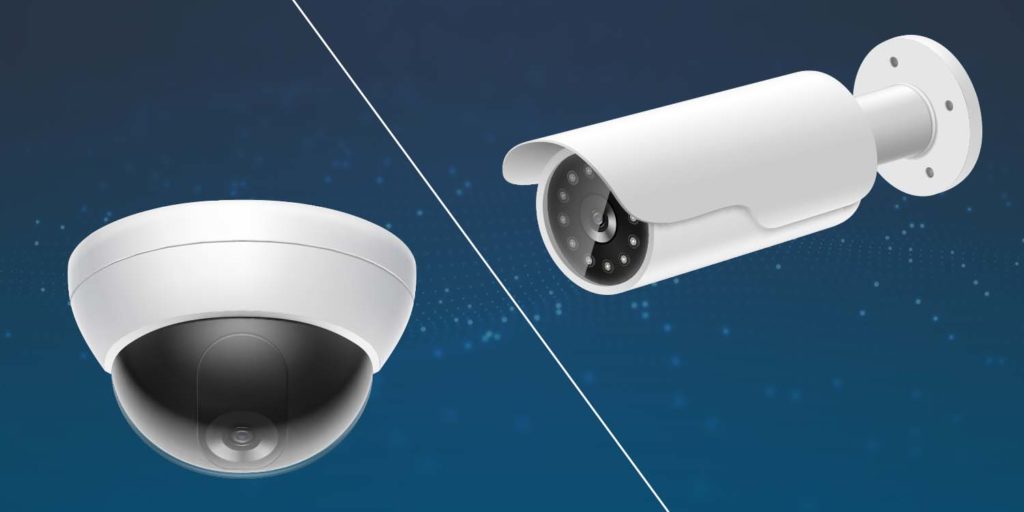
A dome camera is a type of security camera housed within a dome-shaped protective casing. Its compact design enables it to remain relatively unnoticed, while the dome enclosure enhances durability and resistance to vandalism and environmental wear.
These cameras are a popular choice for indoor settings like hotels, restaurants, and offices, but weather-resistant models can also be deployed outdoors.
They typically provide wide-angle coverage and can include features such as HD video, night vision, remote access, and intelligent analytics.
What Is a Bullet Camera?
A bullet camera is a security camera with a long, cylindrical housing that resembles a bullet. The camera’s noticeable design helps deter potential intruders by making surveillance efforts clearly visible.
Commonly used for outdoor security applications, bullet cameras are well-suited for monitoring perimeters, parking areas, loading docks, and gates, while also providing effective long-range indoor coverage when needed. Many models are weatherproof and offer features such as HD video, night vision, remote access, zoom capabilities, and intelligent video analytics.
Difference between Dome and Bullet Cameras
While the most noticeable difference between dome and bullet cameras is their physical design, the distinctions extend beyond appearance and affect how each camera is installed and used.
| Features | Dome Cameras | Bullet Cameras |
| Typically static, hardwired into a wall or ceiling, but they don’t have to be; they can be wireless. Most of the time, however, once they’re mounted, they stay in place. | ✓ | |
| Often wireless, this frees you up to place them in very remote or rural settings. | ✓ | |
| Can easily change direction. Some even allow your security team to move the camera angle remotely. | ✓ | |
| Camera housings are often more vandal resistant, depending on where they are mounted. | ✓ | |
| Should be mounted high up to make them less accessible to vandals. | ✓ | |
| Can work outdoors. | ✓ | |
| Typically have a longer field of vision. | ✓ |
Both camera types share many of the same core surveillance capabilities, including:
- Infrared (IR) LEDs for low-light and nighttime monitoring
- Internet connectivity for remote access and management
- Real-time monitoring by security teams or video surveillance providers
- HD video recording and smart security features available on many models
The key dome camera and bullet camera differences are generally related to camera shape, mounting options, visibility, and intended deployment environments rather than the underlying technology. As a result, choosing between a dome and bullet camera often comes down to the specific coverage, installation, and security requirements of your property.
Dome Cameras Features & Benefits
A dome security camera is enclosed in a hemispherical housing. This housing is usually very tough and made to withstand both indoor and outdoor conditions. Many of the dome camera models on the market today include benefits like:
Discretion
These cameras have a lower profile than bullet cameras. If you look hard, you can spot these eyes in the sky, but it’s easy to pass right by them unnoticed. This stealth makes them ideal for places where people may not expect to be surveilled.
Tamper-Proof Angles
They also hide which direction the lens is pointing, which makes them valuable as a deterrent. Even if a thief can reach the dome camera, they can’t change the direction of the lens.
The Perfect View
The dome design can enclose a wide-angle view camera lens. Usually, dome cameras are equipped with a variable focal field of view, making them suitable for monitoring larger areas with fewer camera units. Your security team can make the adjustments necessary to cover the exact field of view you need.
Installation
Dome cameras are designed for flexible deployment and can be installed in numerous indoor and outdoor environments.
- Versatile deployment: Suitable for ceiling, wall, and overhang installations, dome cameras can be used effectively in many commercial and residential environments.
- Discreet pan-and-tilt functionality: Some models allow remote camera adjustments without drawing attention, which can be useful in environments such as casinos and retail stores.
- Ideal for covert monitoring: Their low-profile design makes it difficult for people to determine exactly where the camera is pointing.
- Limited repositioning after installation: Once installed, changing the camera’s field of view often requires physical adjustments and may require professional assistance.
Durability
These cameras are typically made of tough materials, making them quite durable. They tools last a long time, in part, because the camera’s delicate sensors are encased in a protective shield. You can even purchase a dome camera as “vandal-proof.” This means the camera’s impact protection rating is high.
Aesthetics
Dome cameras are less obtrusive and more aesthetically pleasing, making them excellent for interior spaces or places where a camera should be less noticeable, such as retail establishments, hotels, or office environments.
Privacy Masking
Many dome cameras have privacy masking features that allow particular sections of the camera’s field of view to be hidden or blacked out. This is crucial in situations when some places, such as restrooms or employee-only areas, must not be recorded.
Bullet Cameras Features & Benefits
Compared to the round dome cameras, bullet cameras have a housing that is oblong, or shaped like a bullet. As a result, these cameras are more conspicuous compared to the other type and will typically stand out from a static wall or corner eave. If you want people to know they’re being watched, a bullet surveillance camera is the obvious choice.
Some of the bullet camera models on the market today include these features and benefits:
Portable
They can more easily be moved, so you can change the angle of the lens to cover specific areas of interest.
Outdoor-Proof
The housing can be weatherproofed to withstand even the most intense environmental conditions (including rain, dust, and extreme temperatures).
Eagle Eye
They offer good HD long-distance vision. This can help spot people at great distances or even read a license plate, thanks to zoom camera features. As such, these cameras are commonly used in outdoor applications such as parking lots, perimeters, or entrance gates.
Customized Installation
Unlike dome cameras, which are typically mounted to the ceiling, these cameras are extremely versatile and can be mounted to walls, ceilings, and poles. They can also be wired, wireless, or use solar panels for power.

Bullet Camera vs. Dome Camera: How Much Does It Cost to Install One?
Cost considerations plays an important role when choosing between dome and bullet cameras for a surveillance system. Let’s take a closer look into the costs associated in installing both types of cameras to help you make a decision that aligns with your budget and security requirements.
Bullet vs. Dome Camera: Initial Purchase Costs
Dome cameras are can be cost-effective compared to bullet cameras with similar features and specifications, making them an attractive option for businesses on a budget. Basically, the cost differences vary significantly depending on the brand, model, and features (e.g., resolution, low-light capabilities, zoom capabilities, smart features such as motion detection and facial recognition, etc.). As expected, cameras with more advanced features come with a higher price tag.
Installation Costs
- Mounting and wiring. Dome cameras are typically easier to install on ceilings and walls, resulting in lower installation costs. Bullet cameras, on the other hand, may require more complex mounting solutions, especially when aiming them at specific angles. The cost of wiring can also vary. Bullet cameras often require more extensive cabling due to their different mounting options, resulting in higher labor and material costs. For most business installations, mounting and wiring costs usually range from $100 to $500 per camera, depending on the site layout and installation complexity.
- Power over Ethernet (PoE). PoE is a cost-effective solution for providing power and data to cameras with a single Ethernet cable. Many dome and bullet cameras support PoE, which reduce the need for separate power cables and outlets.
- Professional Installation vs. DIY. Do you want to hire a professional to install the units or would you rather go for the DIY approach? Professional installation ensures proper setup but you have to pay for the associated labor fees. With DIY installation, you can save on professional fees but it requires more time and effort. Professional installation commonly costs between $100 and $300 per camera, while DIY installation can reduce labor costs if you have the necessary tools and technical knowledge.
Generally, DIY installation should only be considered for businesses with straightforward surveillance requirements, such as monitoring a small office or a single entrance, and if you or your staff have some level of technical expertise in working with networking, power, and cabling. Otherwise, better leave it to the pros.
There are several reasons why you should let the experts handle the job. - They have ample experience and can handle the unique and often complex surveillance requirements of your business establishment.
- They can determine the best locations and angles for cameras to achieve the desired coverage.
- Professional installers can customize your surveillance system and ensure seamless integration with other security measures, such as access control systems, alarms, or advanced analytics.
- They can accurately align your surveillance system with industry-specific regulations and/or privacy laws.
- They offer warranties and ongoing support.
Long-Term Costs
- Maintenance. Both dome and bullet cameras require regular maintenance (cleaning the lenses, checking for firmware updates, addressing technical issues, etc.) to ensure their functionality; costs can vary based on camera brand and model.
- Storage costs. Long-term video storage can be a significant cost, especially for high-resolution cameras capturing large amounts of footage, so don’t forget to factor in the cost of Network Video Recorders (NVRs), cloud storage subscriptions, or local storage solutions.
- Software and licensing. Some surveillance systems may require software licenses for features like advanced analytics or remote access.
- Upgrades and expansion. Expanding your surveillance system or upgrading to more advanced cameras in the future can require purchasing new cameras, integrating them into the existing system, and potentially replacing older units.
- Cloud-based vs. local storage. Using cloud-based storage solutions for video footage may be more convenient but it comes with ongoing subscription fees which may be determined by the amount of data storage required and the chosen cloud provider. On the other hand, local storage options (NVRs, hard drives, etc.) have a higher upfront cost but frees you from recurring cloud storage fees.
Key Factors to Consider Before Choosing a Security Camera
Lighting, Night Vision, and Smart Features
When comparing bullet camera vs dome camera options, another crucial factor is the lighting environment.
-
Dome cameras are often equipped with infrared (IR) LEDs or low-light sensors that allow them to perform well in dimly lit indoor spaces. An indoor dome security camera is particularly well-suited for offices, retail stores, hotels, and other interior environments where reliable low-light performance and discreet monitoring are important.
-
Bullet security cameras, on the other hand, tend to offer superior night vision due to their larger size, which can accommodate more powerful IR LEDs. If night visibility is a key concern — such as monitoring a parking lot or exterior gate — a bullet camera may provide clearer imaging.
Additionally, many modern dome and bullet cameras offer intelligent video analytics, such as motion detection, people counting, or license plate recognition.
Businesses that prioritize data-driven insights should consider which type of camera — dome or bullet — better supports their surveillance goals through integration with analytics platforms.
Connectivity: Wireless vs. Wired Cameras
Another decision point in the dome vs bullet security cameras debate involves the method of connectivity.
- Wireless cameras: Wireless dome cameras, particularly dome wireless security camera systems, are popular in small and mid-sized business environments where flexibility and ease of installation are important. They reduce cable clutter and are easier to reposition, but they should be properly secured to minimize the risk of interference or unauthorized access.
- Wired cameras: Many bullet IP cameras support wired connections, including Power over Ethernet (PoE), which delivers power and data through a single cable. Wired systems generally provide more reliable performance and are often preferred for mission-critical applications such as warehouses, financial institutions, and industrial facilities.
Dome vs. Bullet Security Cameras: Comparison Table
| Feature | Dome Camera | Bullet Camera |
|---|---|---|
| Design | Dome-shaped, compact | Cylindrical, more noticeable |
| Best Use | Indoor or vandal-prone areas | Outdoor or long-range surveillance |
| Installation | Ceiling or wall mount | Typically wall or pole mount |
| Field of View | Wide-angle, ideal for broad coverage | Narrower, focused view for long distances |
| Visibility | Less noticeable, more discreet | Highly visible (can deter intruders) |
| Weather Resistance | Moderate, often with protective covers | Typically weatherproof for outdoor use |
| Vandal Resistance | High (vandal-proof casing) | Lower compared to dome cameras |
| Night Vision | Wide-angle IR coverage | Often has more powerful IR LEDs |
| Deterrence Factor | Low (due to discreet look) | High (visible presence can discourage crime) |
| Aesthetics | Sleek, blends into environment | Bulkier, industrial appearance |
| Maintenance | Less dust/cobweb build-up | May attract dirt and need more cleaning |
Dome Camera vs. Bullet Camera Use Cases
While both camera types can provide effective surveillance, certain environments and security objectives make one option more suitable than the other.
When to Use a Dome Camera
Dome cameras are often the better choice when discreet monitoring and wide-area coverage are priorities.
These cameras are commonly used in:
- Office buildings and corporate spaces
- Retail stores and shopping centers
- Hotels, restaurants, and hospitality venues
- School hallways and indoor common areas
- Locations where vandal resistance is important
- Areas requiring a less obtrusive security presence
When to Use a Bullet Camera
Bullet cameras are ideal when visibility, long-range monitoring, and outdoor durability are key requirements.
These cameras are well-suited for:
- Parking facilities and garages
- Building perimeters and fence lines
- Loading docks and storage yards
- Entry and exit points
- Industrial facilities and warehouses
- High-crime areas where a visible deterrent is beneficial
Can You Use Dome and Bullet Cameras Together?
Many businesses achieve the best results by combining dome and bullet cameras within the same surveillance system. Since each camera type has distinct strengths, using both can provide more comprehensive coverage and improve overall security.
A common approach is to use:
- Dome cameras for indoor areas such as lobbies, offices, retail floors, and hallways where discreet, wide-angle monitoring is preferred.
- Bullet cameras for outdoor locations such as parking facilities, building perimeters, loading docks, and access points where long-range visibility and deterrence are important.
By strategically placing both camera types, businesses can maximize coverage, reduce blind spots, and tailor surveillance to the specific requirements of each area. This hybrid approach is often the most effective way to balance visibility, deterrence, and monitoring capabilities across an entire property.
Dome vs. Bullet Camera: Which Security Solution Fits Your Needs?
If you’re considering a dome camera vs. a bullet camera for your business, what you choose depends on what you need. Ask yourself:
- What are the types of areas I’m trying to cover?
Generally, dome cameras are more commonly used indoors due to their discreet design while bullet cameras are more suitable for outdoor applications due to their weather-resistant construction. For example, dome cameras may be more suitable in a hotel lobby, boutique clothing store, or restaurant where preserving the right ambiance is crucial, whereas bullet cameras may be the right choice for outdoor applications, industrial settings and high-crime areas.
Keep in mind you can combine dome and bullet cameras. You can also individualize key features on each unit depending on where they’re placed. - What kind of visibility does each camera need?
Do I need night or thermal vision? Do I need to cover a wide angle? Should I be able to pan and tilt the camera or widen the view from my smartphone? What image resolution is best? - What are the types of environmental hazards the camera will endure, like weather or heat?
Do they need to be tamperproof? - What kind of installation will I need—and what can I support?
- Could solar panels prolong my battery life?
Should I hardwire the units? Do they need to be mobile? - Who is the audience I’m surveilling?
Workers? Customers? Trespassers at night? Can the camera work as a deterrent if it’s visible? Would adding audio and visual elements to the camera scare away potential thieves and vandals?
Obviously, you should be asking these and other questions when considering a dome vs. a bullet camera for your business. Before trying to figure this out we have a better question to ask: Is this something you should leave to chance? Pro-Vigil not only has the right questions you should be asking but we also have the answers. There’s no need for you to struggle with deciding between a dome camera vs. a bullet camera. Pro-Vigil’s experienced team guides you through selecting, installing, and optimizing the right camera types to ensure your business’s security needs are fully met. Contact us for a free consultation today. We’re here to help protect what matters.
FAQ: Dome vs. Bullet Security Cameras
Neither is universally better. The right choice depends on your:
- Surveillance goals
- Installation location
- Desired level of visibility
Bullet cameras are commonly preferred for outdoor use because they offer long-range visibility and are often designed to withstand harsh weather conditions. Many outdoor bullet security cameras also feature weatherproof housings, enhanced night vision, and powerful zoom capabilities, making them well-suited for monitoring parking areas, perimeters, and access points.
Generally, yes. Their enclosed housing and compact design make dome cameras more resistant to tampering and physical damage.
Bullet cameras often provide stronger night vision since their larger housing can accommodate more powerful infrared (IR) illuminators.
Many dome cameras are weather-resistant and designed for both indoor and outdoor applications. Outdoor dome security camera systems are commonly used to monitor building entrances, walkways, parking areas, and other exterior locations where discreet surveillance and vandal resistance are important.
Their long-range capabilities and focused field of view make bullet cameras a popular choice for license plate monitoring.
In many cases, yes. Combining both camera types can provide comprehensive coverage for indoor and outdoor areas.
Most quality security cameras last 5 to 10 years, depending on the environment, usage, and maintenance.
Many modern models support AI-powered features such as motion detection, people counting, facial recognition, and license plate recognition.
Bullet cameras are much easier to install. They feature an external, adjustable neck joint that allows a technician to quickly aim the lens and lock it in place with a single screw. In contrast, dome cameras require removing the outer plastic shell, manually adjusting an internal lens gimbal, and reassembling the housing, which adds steps and increases the risk of night-vision glare issues.
Not necessarily. Dome cameras are often better for discreet, wide-area coverage and vandal resistance, while bullet cameras excel at long-range outdoor surveillance and visible deterrence. The best option depends on your security requirements.
Dome cameras typically provide a wider field of view, making them ideal for monitoring large indoor areas. Bullet cameras generally offer a more focused view and longer viewing distances, making them better suited for outdoor surveillance and perimeter monitoring.
What is a bullet security camera?Yes. Dome cameras are ideal for indoor surveillance due to their compact design, wide field of view, and unobtrusive appearance. They're perfect for retail stores, restaurants, and office spaces.
Yes, bullet cameras can be used indoors, especially in large open areas like warehouses or corridors where long-range visibility is needed. However, they are more noticeable than dome cameras.
Generally, yes. Bullet cameras often have more powerful IR LEDs or longer-range night vision features due to their larger housing, making them ideal for outdoor nighttime use.
The main difference lies in design and installation:
- Dome cameras: Compact, discreet, wide-angle, better for indoor use.
- Bullet cameras: More visible, better long-distance vision, typically preferred outdoors.
Dome cameras are often slightly more affordable and easier to install. However, high-end features can drive up prices for either type.
Dome cameras typically have wider viewing angles, especially those with varifocal or fisheye lenses.
Bullet cameras are generally better suited for outdoor use due to their weatherproof housing and longer-range vision.
Dome cameras are more discreet thanks to their low-profile, ceiling-mounted design and opaque dome casing.Which security camera should you use? [Dome vs. Bullet]
It depends on your environment. Generally speaking:
- Choose dome for indoor, discreet surveillance with wide angles.
- Choose bullet for outdoor, high-visibility deterrents and long-range views.