Quick Answer
Virtual guards are powerful tools who can help secure property via live monitoring and threat verification – but there are ultimately limits to not being on site. In this blog, we look at what virtual security guards can and can’t do to protect your business.
Key Takeaways
- Virtual guards can watch large amounts of property at once via multiple cameras and can identify and verify threats in real time
- They can respond to intrusion with audio warnings, alarms, or dispatching police
- However, they can’t physically detain a trespasser or provide in-person aid or reassurance like an on-site guard can
Today there is a new and less expensive way to secure your property. The internet and AI-enabled security cameras have together created a new service known as the virtual security guard. It’s a more efficient way for businesses to use human eyes to guard their assets.
Traditionally, a live guard patrol protects property, but these guards are expensive. Now you can let cameras do the hard work of observing your business 24/7/365. On the other end of the surveillance camera, a remote security guard can monitor the entire property through a screen.
What is a Virtual Security Guard?
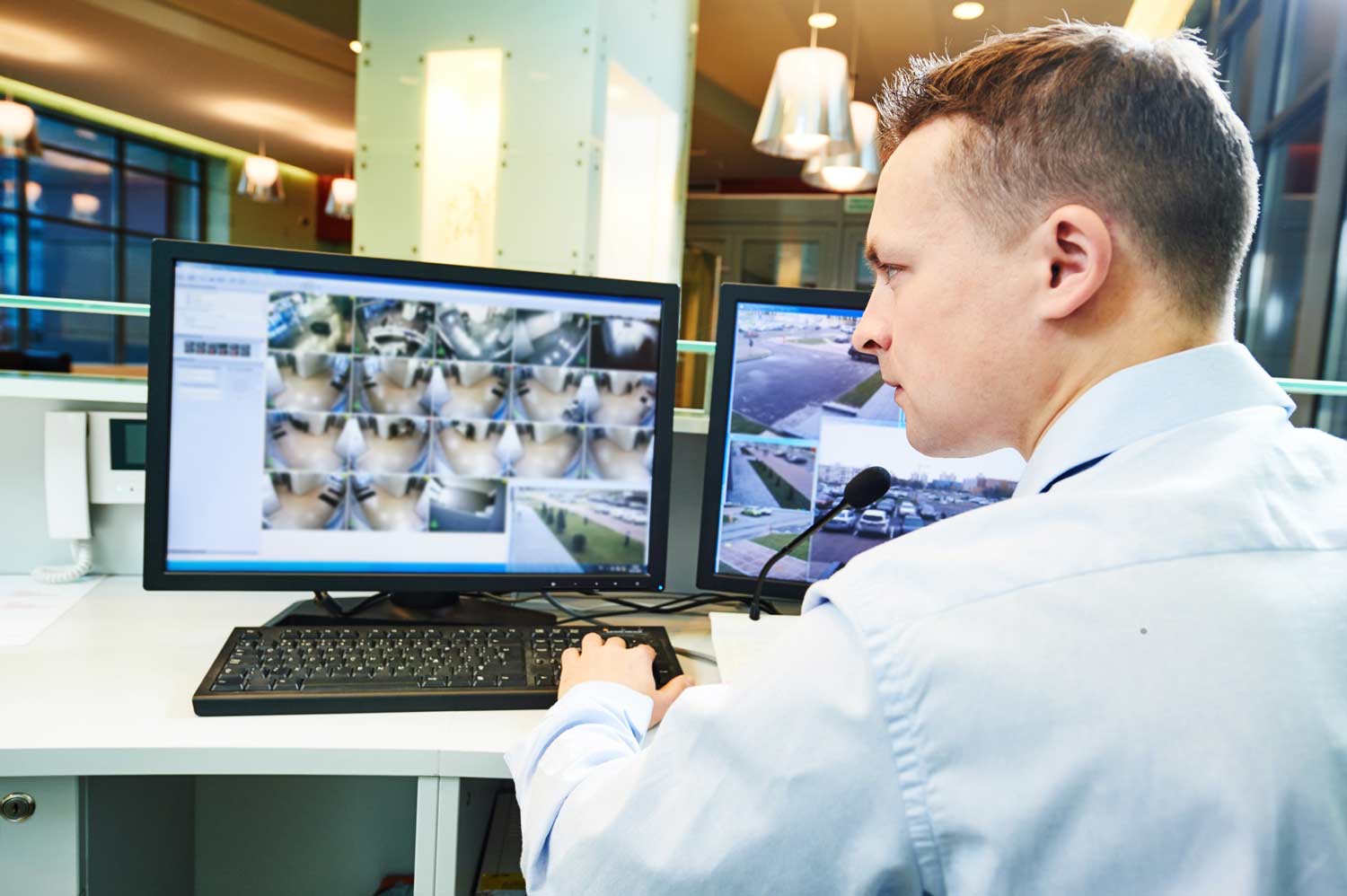
A virtual security guard, sometimes called a remote security guard, watches your property from afar through video surveillance cameras. Remote monitoring systems incorporating virtual security guards require several components:
- IP-enabled security cameras connected to the cloud
- A secure internet connection on your property
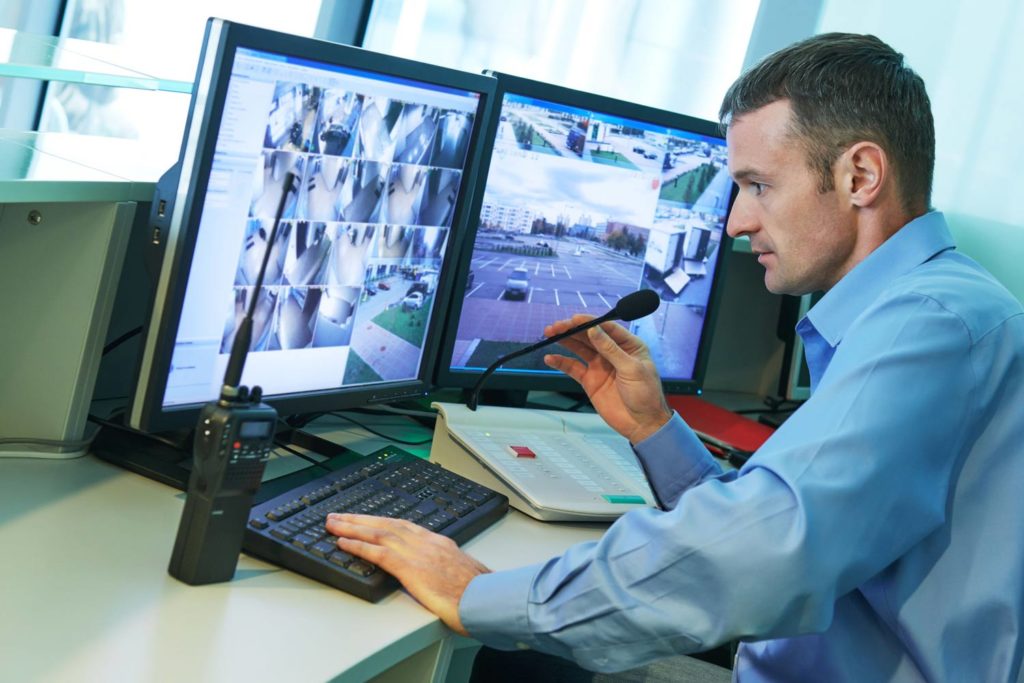
- An off-site security facility where trained security guards watch your cameras via a bank of computer monitors
A virtual security guard can capture high-definition video footage while monitoring your property from every angle. This real-time service is much more effective than an on-site live guard. When you have a live guard service, they must be in the right place at the right time to catch criminal activity. What happens when they turn away? Conversely, what liability do you face if that guard is able to catch a criminal in the act – and might get hurt trying to stop them?
With technology, the old ways of securing your property are obsolete. Now we have tools to see farther and respond faster than ever before. Let’s review what remote security guards can and can’t do to understand this service better.
Virtual Security Guards: Can vs. Can’t, At a Glance
|
A Virtual Security Guard CAN |
A Virtual Security Guard CAN’T |
|
Watch every camera on the property at once, with no blind spots from patrol routes |
Be physically present on-site to intervene in person |
|
See in low light or full darkness with thermal or infrared cameras |
Physically detain or restrain a trespasser |
|
Issue live two-way audio warnings and trigger alarms or lights |
Fix a small physical issue noticed on camera, like closing a window |
|
Verify a threat is real before escalating a response |
Provide the reassurance of an in-person presence for visitors or staff |
|
Dispatch police, fire, or EMS in real time |
Act as licensed law enforcement or make an arrest |
|
Record, timestamp, and document every incident automatically |
Guarantee zero false alarms; technology can still miss or misread activity |
What Can a Virtual Security Guard Do?

A virtual security guard has significant benefits over its on-site counterparts. A virtual security guard:
- Sees farther
- Stays safer
- Responds faster
Live Monitoring and Coverage
A remote security guard can watch all four corners of your property simultaneously. The increased visual reach offers an advantage over a team of on-site guards. No matter how many live guards you use, they can’t be everywhere at once. When a live guard leaves a physical area, it creates vulnerabilities that you just have to live with if you have an on-site security service.
High-definition cameras see further and into the darkest corners. Human security guards may have trouble seeing in low-light conditions. A virtual security guard can use cameras specially equipped for low light conditions to see, literally, everywhere on your property.
Threat Verification
Not every alert is a real threat. A virtual guard’s job includes reviewing what the camera and AI analytics flagged before taking any action, confirming whether it’s an actual person in a restricted area, or just a passing car or a stray animal. This verification step is what keeps a virtual guard’s response accurate, as opposed to a “dumb” security system that just triggers on detected motion.
Audio Warnings & Deterrence
Virtual security guards can respond quickly to suspicious situations. They can respond without putting themselves at risk. The guard can even engage a potential criminal from afar with modern video surveillance tools. For example, if a person enters a restricted area after hours, a remote security guard can talk to them through a two-way speaker on the camera. This interaction protects your business while also protecting the human guarding your property.
Remote security guards can also control cameras from their off-site monitoring station. Depending on the type of camera, they can zoom or pan, record, or even address an intruder. Modern video surveillance cameras offer audible and visual alarm features, too. Imagine a trespasser confronted by a loud alarm and flashing lights, or their surprise when a camera starts questioning what they’re doing.
Emergency Response Protocols
Virtual security guards can also follow specific security protocols that you create. For example, you can use this service to monitor employee behaviors to potentially catch OSHA violations. A virtual security guard can help prevent on-the-job injuries, and a virtual guard service is just as effective at deterring criminal behavior as it is at spotting insider theft. You can also use a remote guard service as a virtual concierge to greet guests at a building, or to help with parking management at large facilities or events. If a situation escalates, the guard follows a set protocol: verify the threat, issue a warning, and dispatch police or fire services if it doesn’t resolve.
Documentation & Reporting
Every event a virtual guard responds to is recorded and time-stamped, and Pro-Vigil’s system automatically tags footage based on what happened. That gives you a searchable record you can pull for an insurance claim, an HR investigation, or a police report, rather than trying to scrub through hours of raw footage after the fact.
Live virtual guards have all of the benefits of an on-site security presence without the risks. This service is also less expensive than hiring on-site guards. But what can’t virtual security guards handle? Are there any drawbacks?
What Can’t a Virtual Security Guard Do?

A remote security guard can’t be on-site at your property to interact with a criminal. Depending on your mindset, this can be a good or bad thing, as discussed above. The physical presence of a human being on your property may deter crime. However, using security guards at your property also increases the risk that they will encounter a dangerous situation that could harm them. No one wants to see that person hurt. Even the best-trained on-site security teams are not the police.
Furthermore, no immediate on-site assistance is available for someone at your business. While a remote guard can talk to a person through the two-way speaker system, they simply are not there. The job of a virtual guard is to communicate with anyone on-site after hours, or to respond appropriately by dispatching first responders. If you’re using this service to monitor existing employees in real time, their job may be to document behaviors.
No matter how you use a virtual security guard service, they are not on-site. Depending on your mindset and needs, this could be a benefit or a drawback. For instance, an on-site security guard can notice a window an employee left open, or turn off a faucet left running. A virtual security guard might notice these things, but would have to dispatch someone to the site to do anything about it.
Would You Like to Know More about What Virtual Security Guards Can and Can’t Do?
Pro-Vigil is a national leader in designing, installing, and maintaining video surveillance. To find out more about our remote security guard service, contact us at 1-866-616-1318.
Pro-Vigil pairs AI-powered cameras with trained live operators, so every alert your virtual guard acts on has been monitored, assessed, and verified. Our monitoring centers operate whenever your business needs protection, and we deter 97% of crimes in progress before they escalate into a break-in or loss.
Whether you need overnight coverage for a single site or a complete monitoring solution across multiple properties, our team can build a virtual guard setup that addresses your business’ unique challenges.
FAQs